Miner’s Rule
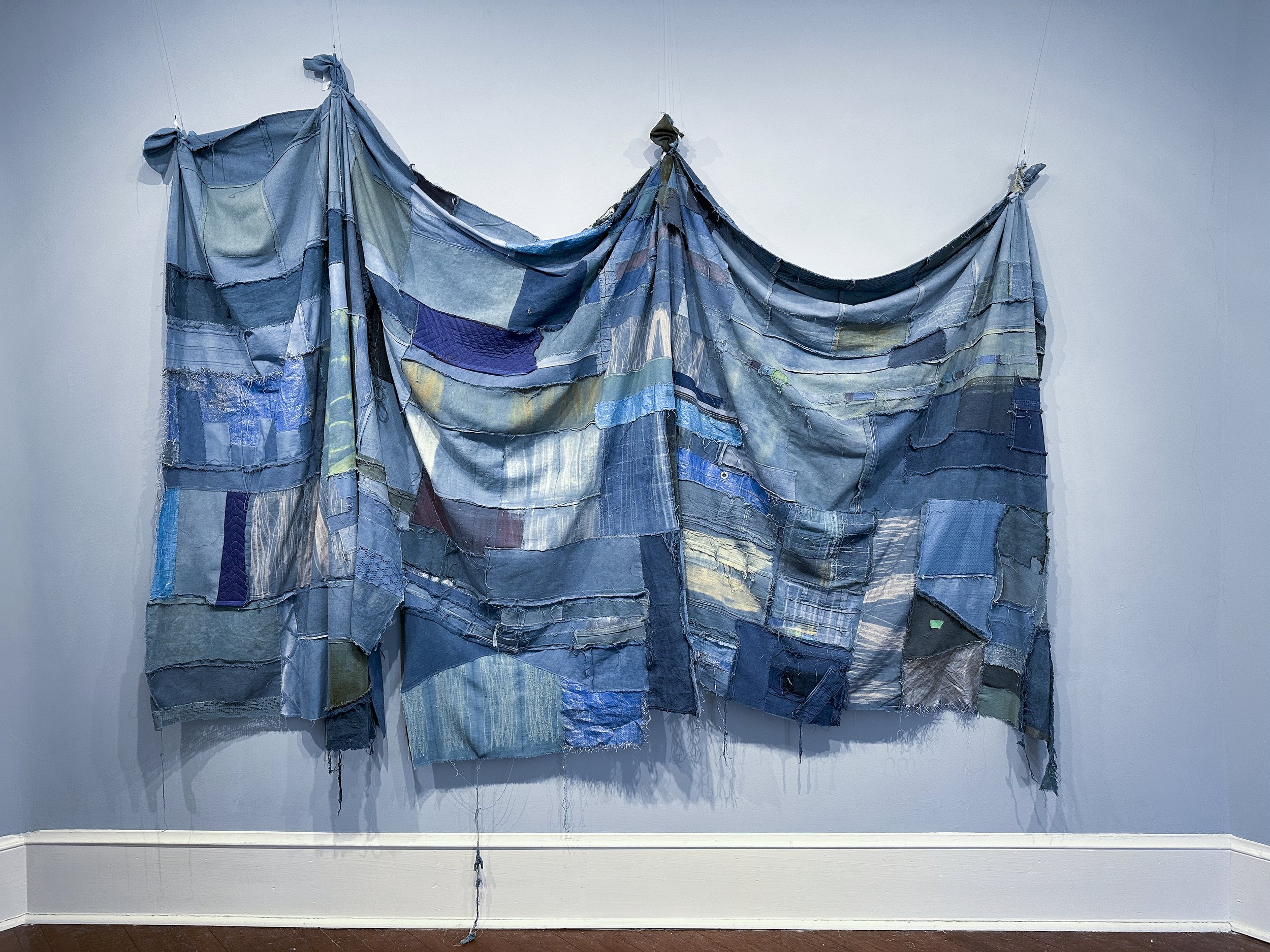
2025
MATERIALS
Procion MX, Myrobalan and Indigo dyed cotton, polyethylene tarp, silk, canvas, moving blanket, thread, drop cloth, found cellulose based textiles
SIZE
144” x 66”
(dimensions variable)
Failure Mode
A Failure mode is the specific way something can fail — a cable frays, a valve sticks open, a step in a procedure is skipped. FMEA (Failure Mode and Effects Analysis) is an industrial, structured, proactive method for identifying how a product, process, or system could fail and what the consequences of each failure would be. It’s used widely in aerospace, automotive, medical devices and manufacturing. The hows and whys are meticulously measured and accounted for.
This project captures the moment of dissolution—the point when the structures, habits, and frameworks that once sustained my life, both practical and emotional, began to break down. The mechanisms I had relied upon disappeared, leaving me to re-evaluate and rebuild.
At the core of my practice is an engagement with the physical properties of materials as the primary driver of form. My process is shaped by the inherent qualities of these textiles—their origins, structural irregularities and the dyes I have used in past projects. I do not erase the asymmetries of found materials but instead allow them to dictate the composition. My actions emphasize texture, surface, and transformation over time, resisting the impulse to impose control and accepting their character when it conflicts with my concept.
The nature of working with found and used materials is that they are close to failure. This work is composed of remnants, pieces from past projects, household linens, and materials I gathered for future work at the Scrap Exchange and the Trosa thrift store in Durham NC. These fragments have now traveled at least 3000 miles with me.
Every scrap in this body of work has been hand-dyed with indigo, a slow, layered process requiring 7-10 dips to achieve the deepest blue colour associated with jeans. Some pieces were part of earlier projects and were dyed, then re-dyed with indigo. The machine stitching, used as a dye resist, becomes a form of mark-making — a record of my presence. These pieces are designed with failure in mind. These start as textiles that have already had a use-life. The nature of the material means the more it is stitched and punctured, dyed fabrics are redyed, the process by which they are made will become the death of them.
The calculation
D = n₁/N₁ + n₂/N₂ + n₃/N₃ + …
The Palmgren–Miner rule or, Miner’s Rule is a way of estimating when something will fail after a mix of stresses of different sizes. Every material has a finite life under a given stress. Under one kind of stress it might survive 1,000 cycles; under a gentler stress, 100,000. Miner’s rule says each cycle uses up a fraction of that life, and the fractions simply add up.